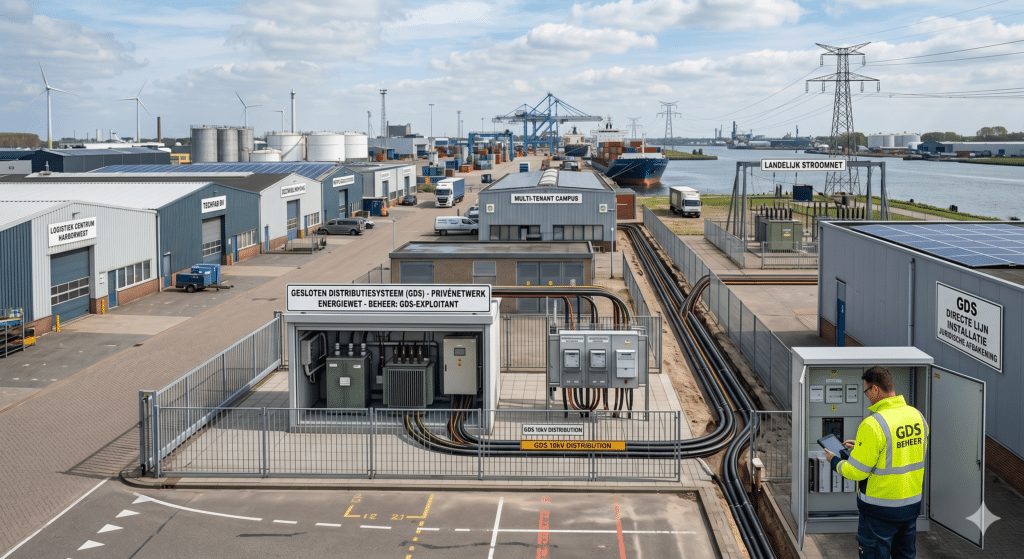
A private network on an industrial site, port, campus or business park is, in legal terms, one of three things under the Dutch Energy Act (Energiewet): a closed system, a direct line or an installation. That classification decides the rules: a closed system needs recognition by the Netherlands Authority for Consumers and Markets (ACM) under Article 3.7, a direct line only a notification under Article 3.9, and an installation behind a single connection neither.
De Enerzjywet has applied since 1 January 2026 and replaced the Electricity Act 1998 and the Gas Act. What used to be called a closed distribution system (gesloten distributiesysteem) is now a closed system (gesloten systeem). Older contracts and site regulations often still use the old terms and article numbers, so check them against the new Act.
Wat is in sletten systeem ûnder de Enerzjywet?
A closed system is an electricity or gas network within a geographically defined industrial or commercial site, or a site with shared services, that the ACM has recognised as such under Article 3.7 of the Energy Act. It serves a limited group of connected parties, fewer than 1,000, and in principle no households.
The regime exists because users on such sites are technically or operationally linked, so the full regime for public grid operators does not fit. A lighter regime is not an unregulated one: the ACM must designate the operator under Article 3.6, and the operator has statutory duties towards connected parties. The conditions for recognition are discussed in detail in our article on CDS recognition from the ACM and in our piece on wannear't in raster kwalifisearret as in sletten systeem.
What happens if a network is not recognised?
The owner of a distribution system must ensure that it is either run by a certified operator or recognised as a closed system, and that an operator is designated (Article 3.1(1) Energy Act). If no operator is designated, the owner must itself act as operator and perform the statutory tasks (Article 3.1(3)). That is usually the outcome a site owner wants to avoid.
How do you distinguish a closed system, a direct line and an installation?
The name the parties give the network is irrelevant; the actual configuration and function decide. Use these three definitions as a test:
- Closed system: a distribution network for several connected parties on a defined site, recognised by the ACM (Articles 3.6 and 3.7).
- Direct line: one or more cables that connect a production installation directly with one or more end users, either completely isolated or connected to the grid through no more than one connected party’s installation (Article 3.9(1)). The owner must notify the ACM as soon as possible after it is put into use, and again after any significant change (Article 3.9(2)).
- Ynstallaasje: cables and equipment used or managed by one connected party, behind the transfer point of its connection, for its own consumption, production or storage (Article 1.1).
Households may only be supplied through a direct line or a closed system if the people concerned work for, or have a comparable relationship with, the owner (Articles 3.7(1)(f) and 3.9(1)(b)).
Why does the classification matter so much?
It determines the operator’s duties, the rights of connected parties, the access of newcomers and the relationship with the public grid operator. A site owner who thinks it runs an internal network may face duties towards users it never priced in. Conversely, a network labelled a closed system without meeting Article 3.7 is exposed to enforcement by the ACM.
What changed for existing site networks on 1 January 2026?
Under the Electricity Act 1998, closed distribution systems worked with an exemption based on Article 15 of that Act. Under Article 7.32 of the Energy Act, such an exemption counts, for its remaining term, as a recognition under Article 3.7 and a designation under Article 3.6.
The transitional rule gives time, not permanence. Check when your exemption ends and prepare the recognition application in good time: the ACM has up to six months to decide, extendable once by six months (Article 3.54 of the Energy Regulation). Review contracts, tariff methods and site regulations against the new provisions rather than assuming they still comply. For new projects, classify the network at the design stage; repairing a structure afterwards is more expensive.
What duties does the operator of a closed system have?
The operator must act reasonably, transparently and without discrimination when performing its statutory tasks (Article 3.24(1), applied to closed systems through Article 3.104 of the Energy Act). The core duties are:
- making an offer, on request, for the use, management and maintenance of a connection and for transport over the system (Article 3.105(2));
- refusing only if there is reasonably insufficient transport capacity, with a proper justification (Article 3.105(3));
- charging tariffs based on a calculation method published in advance that is cost-reflective, transparent and non-discriminatory (Article 3.114);
- keeping a register of connections (Article 4.6) and protecting confidential data of connected parties (Article 3.77, through Article 3.104);
- offering connected parties with a small connection a transparent, simple and inexpensive complaints procedure (Article 3.34 of the Energy Decree).
Owning the site does not mean the owner may run the energy infrastructure at its own discretion. Once a closed system is involved, these public-law duties shape the private contracts on the site.
What rights do you have as a connected party?
As a connected party you can demand a connection and transport offer, a reasoned refusal, and tariffs based on a published method. You can enforce these rights through a complaint to the ACM or through the civil courts.
Are connection, transport and supply separate questions?
Yes. Connection to the system, transport of energy over it and supply of energy by a supplier are regulated separately, and a dispute is handled differently depending on which of the three it concerns. As an end user you remain free to choose your supplier.
The operator must respect that choice. The Arnhem-Leeuwarden Court of Appeal held that a private network operator must take the connected parties’ free choice of supplier into account, although that does not automatically oblige it to arrange an EAN code or a separate connection (ECLI:NL:GHARL:2026:316). Access to the system should not be made conditional on buying energy or other non-network services from the operator or an affiliated company.
Why should you record contracted capacity separately?
A high technical connection capacity does not guarantee the same contracted transport capacity. If you plan to electrify production or install opladen ynfrastruktuer, your connection and transport agreement should state separately:
- the technical connection capacity;
- the contracted transport capacity for offtake and for feed-in;
- the procedure and lead time for increasing capacity;
- the consequences of exceeding the contracted capacity;
- the allocation criteria if capacity becomes scarce.
Who pays for a grid reinforcement?
The Energy Act has no rule on this, so the calculation method and the contract decide. An investment that benefits the whole system cannot simply be charged in full to one connected party under the cost-reflectivity standard of Article 3.114. If you receive a large investment proposal, ask for the technical justification, the expected service life and the extent to which other users benefit.
How does the public grid affect a closed system?
A closed system is connected to the public grid, and most practical problems arise at that transfer point: transport capacity, oerlêst fan it net, expansion of the connection and feed-in from local generation. Congestion management on the public grid is governed by the electricity system code (Systeemcode elektriciteit) adopted under the Energy Act.
When capacity at the transfer point is scarce, the operator must still allocate internal capacity on reasonable, transparent and non-discriminatory terms (Article 3.24(1) through Article 3.104). A refusal of capacity must be concretely justified (Article 3.105(3)); a general reference to congestion is not enough.
How are tariffs and general terms reviewed?
The ACM does not approve closed-system tariffs in advance, but Article 3.114 of the Energy Act requires a calculation method published beforehand that leads to cost-reflective, transparent and non-discriminatory tariffs. A connected party can ask the ACM to test the method or a tariff; if it falls short, the ACM orders an adjustment (Article 3.114(2)). Our article on closed-system tariffs behannelet dit yn detail.
General terms and conditions are tested under the Dutch Civil Code (BW). An unreasonably onerous clause is voidable under Article 6:233 BW, but a company that publishes annual accounts or employs 50 or more people cannot invoke that ground (Article 6:235 BW). Large industrial users therefore rely mainly on the content of the contract itself and on the statutory standards of the Energy Act.
Should you go to the ACM or the civil court?
Both routes are available and do not exclude each other. A complaint to the ACM under Article 5.4 of the Energy Act suits disputes about statutory duties, such as access, tariffs and non-discrimination. The ACM decides within two months, extendable by two months, and its decision is binding (Article 5.4(2)-(3)).
The civil court handles contractual disputes, repayment of overpaid amounts, damages, annulment of clauses and termination. The ACM does not award damages, so after a favourable ACM decision a separate civil claim is usually needed (Article 5.4(4) keeps that route open). In case of an imminent disconnection over a disputed invoice, interim relief proceedings (kort geding) can be brought if there is a genuine urgent interest.
What happens when the operator or the site is sold?
The statutory duties attach to the operator of the system, whoever that is; the ACM must designate a new operator under Article 3.6, and changes may affect the recognition. Whether existing agreements pass to the new operator depends on the transaction structure.
In a share sale, the contracting legal entity stays the same. In an asset sale, contracts do not transfer automatically; a transfer of contract requires the cooperation of the connected party (Article 6:159 BW) unless consent was given in advance. If the operator is at risk of bankruptcy, connected parties should negotiate security early, such as a parent-company guarantee, a maintenance reserve or arrangements in case a trustee does not continue operating the system.
What should you check as the operator of a closed system?
- Are the recognition, operator designation and remaining term of any old exemption in order?
- Has the tariff calculation method been published in advance and can every cost be substantiated?
- Are capacity refusals justified in writing on concrete technical grounds?
- Are your general terms and amendment clauses clear and defensible?
- Have you arranged continuity of operation in case of a sale, restructuring or financial trouble?
Wat moatte jo as ferbûne partij kontrolearje?
- Have you asked for proof of the recognition and the operator designation?
- Does your agreement separate technical connection capacity from contracted transport capacity?
- Do you receive the calculation method and cost substantiation when tariffs change?
- Are capacity requests and refusals documented in writing?
- Do you keep invoices, correspondence and capacity calculations for a possible ACM complaint or court case?
- Have you challenged doubtful tariffs promptly, with limitation periods in mind?
What can we do for you with private networks and closed systems?
Us enerzjy-advokaten advise site owners, operators and connected parties on the structuring, operation and disputes surrounding closed energy infrastructure.
- We classify your network as a closed system, direct line or installation under the Energy Act.
- We prepare recognition and operator-designation applications and the notification of a direct line.
- We draft and review connection and transport agreements, tariff methods and site regulations.
- We file or defend complaints before the ACM and bring civil proceedings, including interim relief.
- We structure the transfer of a network in a site sale or restructuring.
Gearfetting
- A private network is legally a closed system, a direct line or an installation; the actual configuration decides.
- A closed system needs ACM recognition (Article 3.7) and a designated operator (Article 3.6); a direct line needs a notification (Article 3.9).
- Old Electricity Act exemptions count as recognition only for their remaining term (Article 7.32).
- The operator must offer connection and transport, justify refusals and charge tariffs under a published, cost-reflective method.
- Connected parties can complain to the ACM (Article 5.4) and go to the civil court for contractual claims and damages.
Faak Stelde Fragen
Is a private network the same as a closed distribution system?
No. “Private network” is not a legal term. Under the Energy Act a private network is a closed system (recognised by the ACM under Article 3.7), a direct line (notified under Article 3.9) or an installation behind a single connection.
Wat hat de Enerzjywet feroare foar besteande partikuliere netwurken?
The closed distribution system is now called a closed system and needs ACM recognition. An exemption granted under Article 15 of the Electricity Act 1998 counts as a recognition and designation only for its remaining term (Article 7.32 Energy Act).
Kin de operator in ferbining of in útwreiding wegerje?
Only if there is reasonably insufficient transport capacity on its system, and the refusal must be properly justified (Article 3.105(3) Energy Act).
Mei de operator syn tariven frij ynstelle?
No. The tariffs must follow from a calculation method published in advance that is cost-reflective, transparent and non-discriminatory (Article 3.114). The ACM can order an adjustment after a complaint.
Wat bart der as de operator ferkocht wurdt?
The statutory duties stay with the system and a new operator must be designated. In an asset sale, your agreement only passes to the buyer with your cooperation (Article 6:159 BW), unless you consented in advance.